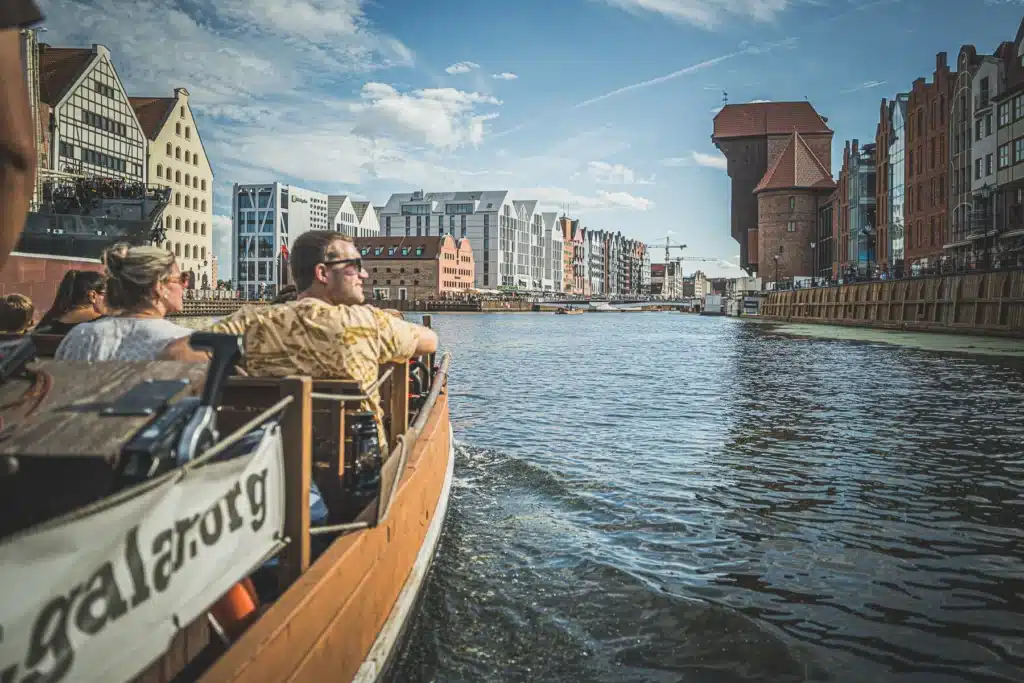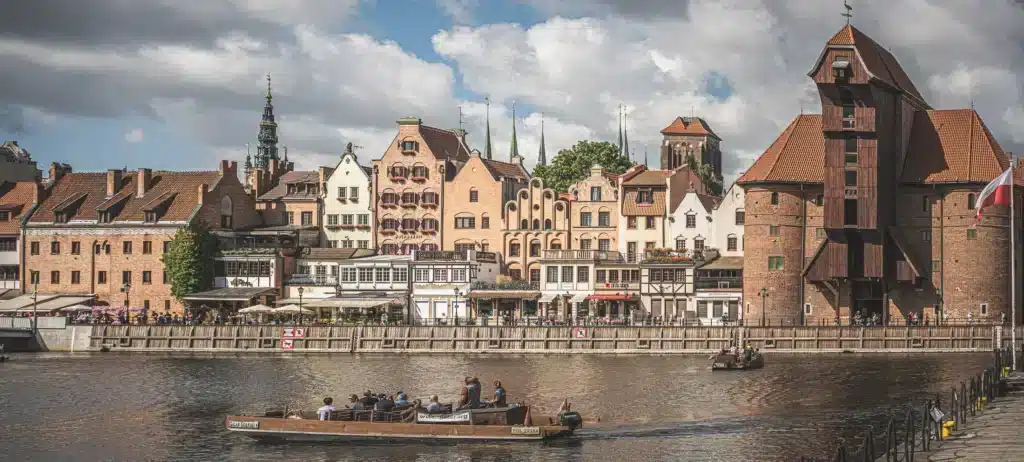


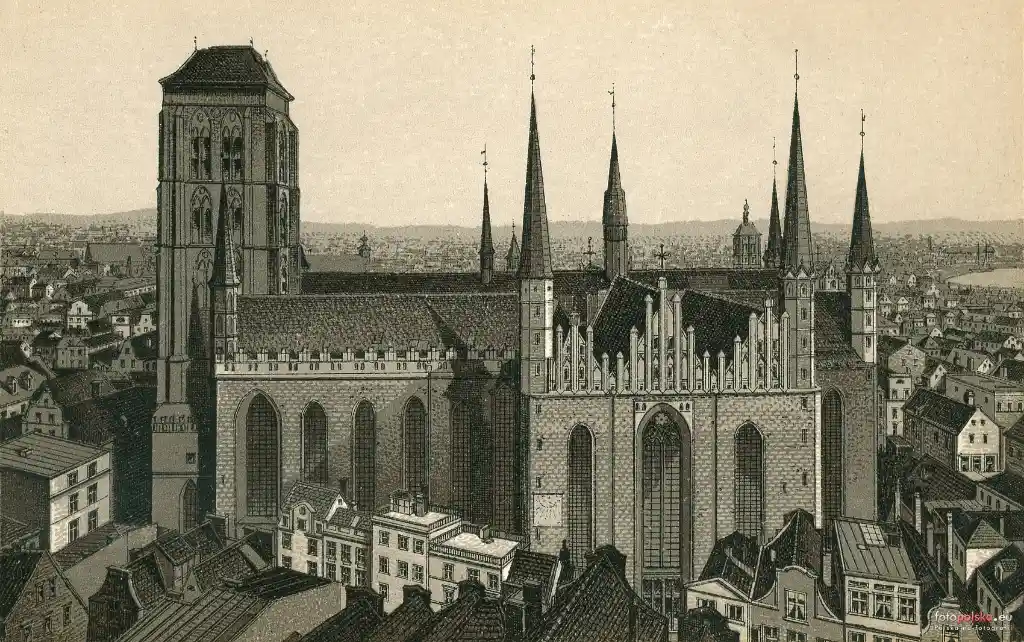

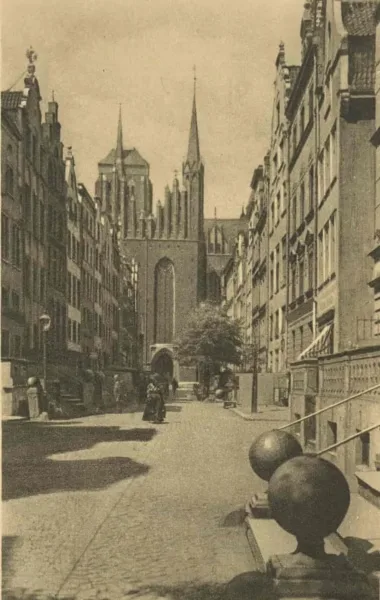
St Mary’s Church can be recognised from many places in Gdańsk, including from the water. Its mighty tower and sweeping roofs rise above the tenement houses of the Main Town. Their scale serves as a reminder of the ambitions of the community which, over successive generations, built and furnished its most important church.
A construction project lasting longer than a human lifetime
Construction of the present church began in 1343. The completion of work on the vaults in 1502 marked the end of a 159-year period. It was therefore not a single project carried out from start to finish by the same people, but an undertaking developed over several generations.
During this time, the city’s political relations and living conditions also changed. The church was built in Gdańsk under the rule of the Teutonic Order, whilst its completion took place during the city’s period of association with the Kingdom of Poland. The endowments for the chapels and furnishings reflected the importance of local families and guilds.
A basilica with a hall-style interior
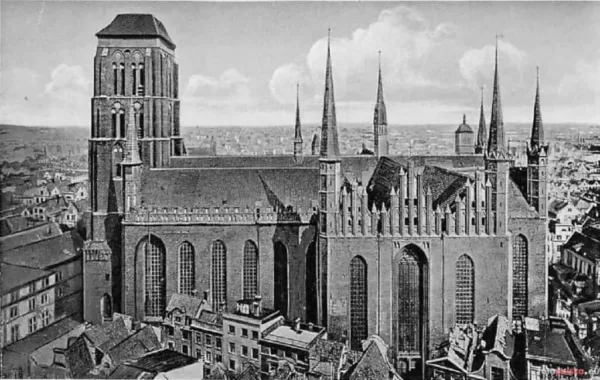
The name ‘St Mary’s Basilica’ refers to the church’s liturgical status. However, this does not mean that its current interior has a basilica layout in the architectural sense. The Gdańsk church is a monumental Gothic hall: its naves are of similar height.
This is an important distinction, evident as soon as one steps inside. The tall pillars and vaults create a vast space, the scale of which cannot be fully appreciated simply by looking up at the tower. The brick structure ranks among the city’s most significant achievements in Gothic architecture.
The clock that told the story of the order of the world
One of the most valuable artefacts in the interior is the astronomical clock, crafted between 1464 and 1470 by Hans Düringer of Toruń. It is over 14 metres tall and comprises a calendar, a planetarium and a figure theatre.
Its functions went beyond simply telling the time. The elaborate dials displayed calendar and astronomical information, whilst the figures added a sense of movement to the display. The clock combined craftsmanship, mathematics and art — fields which, in a prosperous city, could come together in a single commission.
Religious changes and the catastrophe of war
In the 16th century, the Reformation gradually transformed the life of the church. For a time, Catholic and Protestant services co-existed here, after which the church became a Lutheran church. This chapter in its history lasted until the end of the Second World War.
In 1945, fires and structural damage destroyed the roofs and part of the vaults. Some of the furnishings were saved thanks to having been moved out of the city beforehand. The reconstruction required both building work and many years of conservation of the historic monuments.
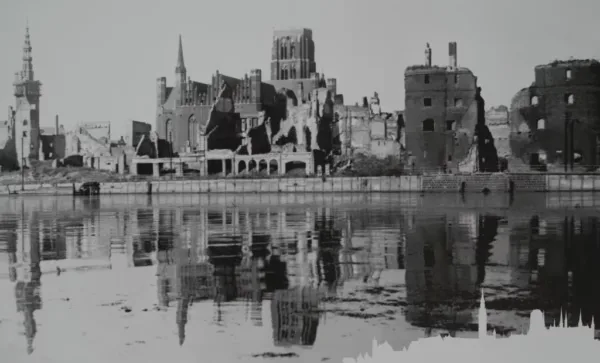
The church was reconsecrated in 1955. In 1965, it was granted the title of minor basilica, and in 1987 it became a co-cathedral. Its present appearance therefore combines the medieval structure with the results of the post-war rescue and restoration of the historic building.
The church has also become the subject of local legends. One of these, about a boy and bells that saved Gdańsk from the plague, is described separately in the post ‘The Legend of St Mary’s Church’.