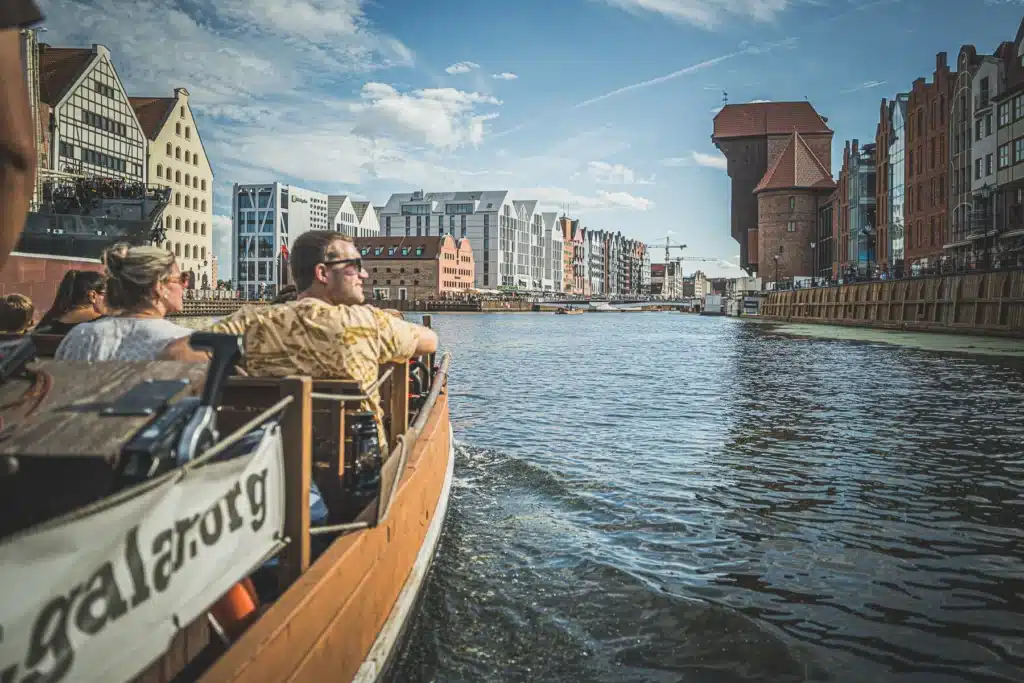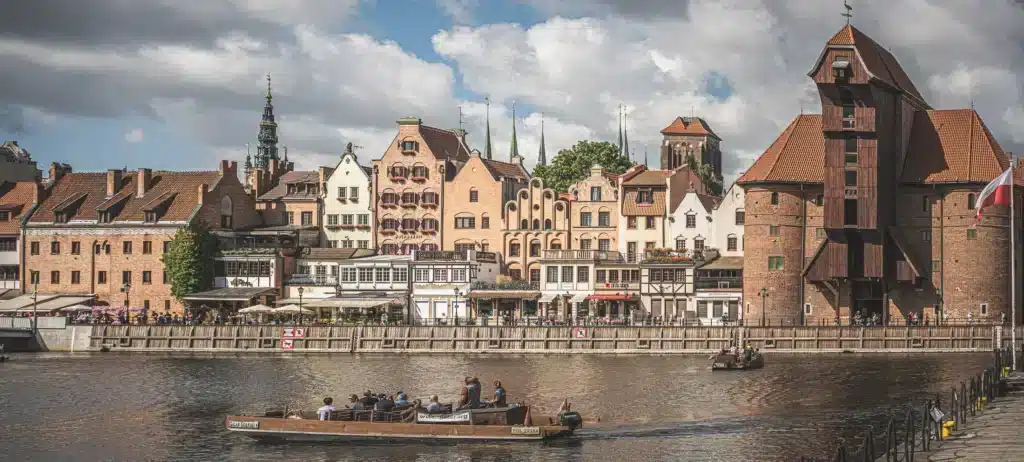


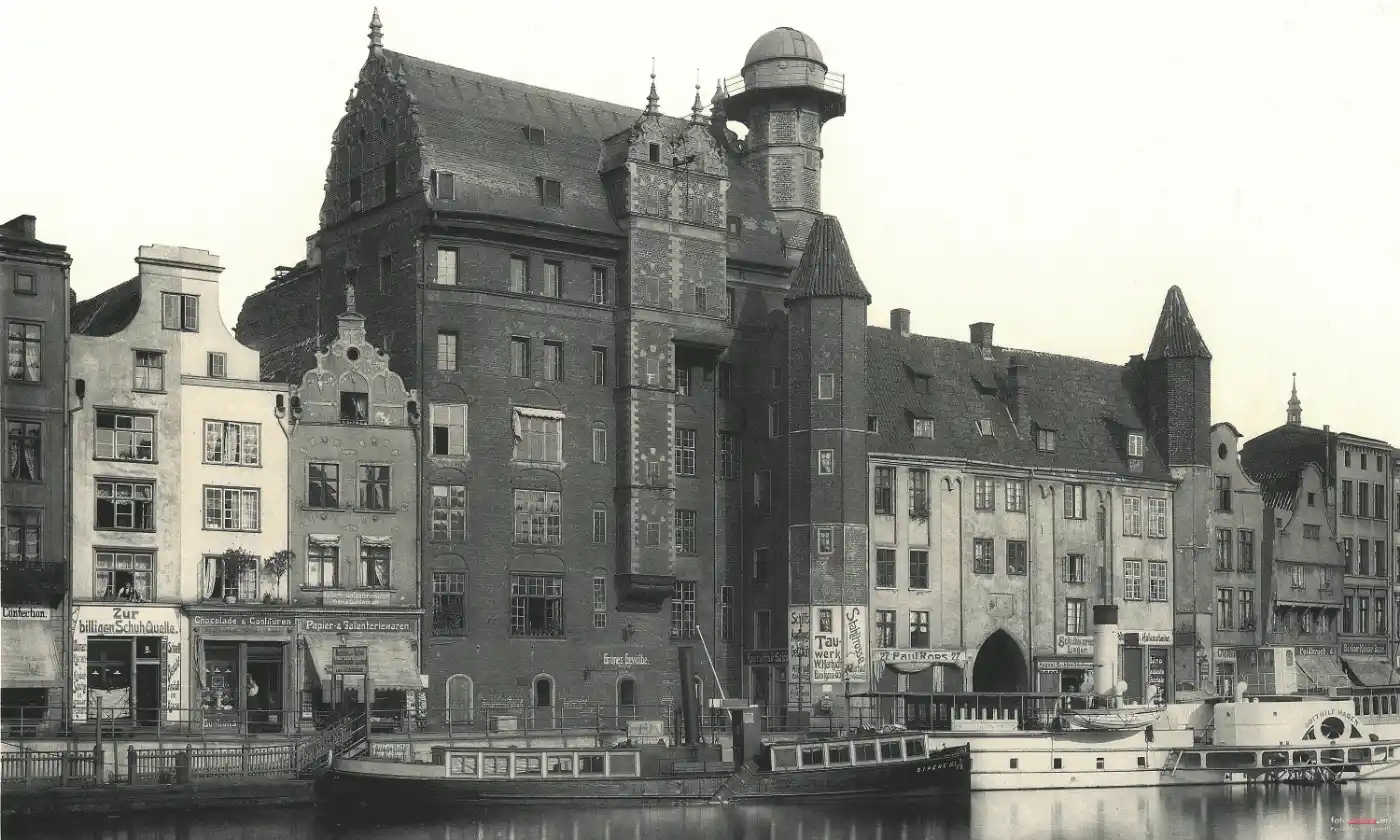

Right next to St Mary’s Gate, at the junction of Mariacka Street and Długie Pobrzeże, stands an imposing tenement house with a tall turret. Its elaborate structure is easily recognisable from the Motława River. However, its current name does not derive from its first owner, but from the scholars who moved in here with their collections much later.
Originally a merchant’s house
The building was constructed in the late 16th century for the merchant Hans Köpe, on the site of an older Gothic townhouse. Its location was well-suited to commercial Gdańsk: the waterfront ran right alongside it, and through St Mary’s Gate one could walk straight from the street to the harbour.
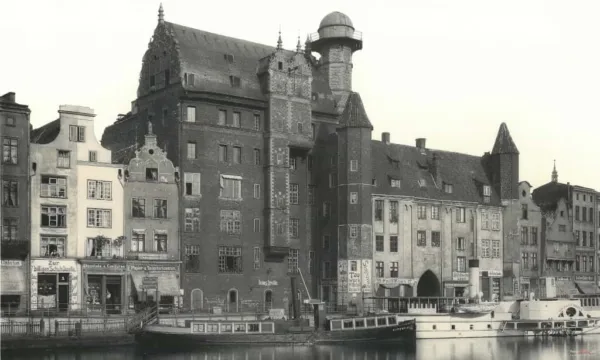
Historical photographs allow us to view the building from the river’s perspective. Its large roof, decorative gables and turret make it stand out amongst the neighbouring façades. At the same time, it is closely integrated with its surroundings — the gate, the street and the narrow strip of waterfront.
A century in the hands of naturalists
In 1845, the Naturalists’ Society purchased the townhouse. It remained in the Society’s possession for the next hundred years. Exhibitions of natural history and archaeological collections were held in its rooms, whilst the scientific reading room provided access to a library of around 20,000 volumes.
The merchant’s house thus took on a new purpose. A place previously associated with the life of a port city now served to gather knowledge, conduct research and display collections. It is precisely this chapter in history that has been immortalised in the name ‘Naturalists’ House’, which is still used today.
The observatory above the rooftops
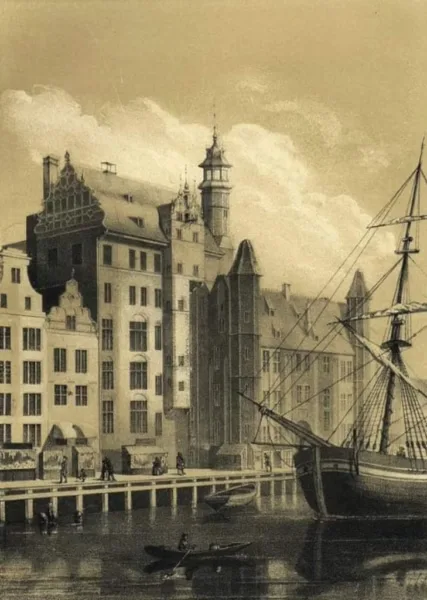
Between 1866 and 1867, the top of the turret was rebuilt, replacing the former spire with a rotating dome for an astronomical observatory. This distinctive change can be seen in old photographs. The building thus also served as a place for observing the sky.
This is a detail worth spotting in a photograph before taking a stroll along the Motława. Comparing old and current views reveals that the monument has not always looked exactly the same. Its form has changed in line with the needs of its users.
Destruction and reconstruction
The Naturalists’ House was severely damaged in March 1945. However, it did not disappear entirely: the front façade with its tower survived. Reconstruction took place between 1956 and 1961. The external form was restored to resemble the historical one, but the former interior layout was not recreated.
The Archaeological Museum has since been housed in the building. The history of the building itself thus tells a story of the evolving ways in which the past has been explored and preserved: from a merchant’s house, through a centre for scholars, to a museum.
Whilst exploring Długie Pobrzeże, it is well worth pausing here. Behind the familiar façade lies the history of Gdańsk’s scientific community, and archival photographs help us to discern it in the building’s details.